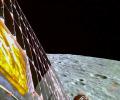
As scientists at the Indian Space Research Organisation (ISRO) gear up for the much-awaited soft landing of the Chandrayaan-3 spacecraft on the Moon's surface, the space agency may postpone the touchdown to August 27 in the event that health parameters of the lander module are found to be "abnormal", a senior official has said.
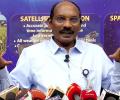
Sivan said the Indian National Space Promotion and Authorisation Centre (In-Space) has been created under the Department of Space as a separate vertical for taking independent decisions with respect to permitting and regulating space activities of the private sector.

The Chandrayaan-2 will conduct the next level of scientific studies on the Moon, writes T E Narasimhan.

So, if ISRO is able to revive them as the Sun rises on the Moon again, information that is derived from experiments that could once again be conducted by the Chandrayaan-3 payloads would be a "bonus".

India on Tuesday said cooperation in peaceful uses of nuclear technology is an important pillar of the multifaceted cooperation with Russia, which offered help in building small tropical nuclear power stations.

The Indian Space Research Organisation has resolved to alight its lander on the lunar surface with Chandrayaan-3 in addition to a maiden solar expedition in 2020.

NavIC consists of a constellation of seven satellites and a network of ground stations and is touted to be more accurate than GPS.

The year ended with the launch of the PSLV's 50th mission.

Tata Group is in discussions with some major international companies, including those from Taiwan, for its foray into the semiconductor chip business. The Union government had earlier tried to bring in Taiwanese manufacturers Taiwan Semiconductor Manufacturing Company (TSMC) and United Microelectronics Corporation (UMC) for chip manufacturing in India. A person close to the development said the Tatas have now opened a separate channel for a possible tie-up. Currently, India mostly imports chips, which are fabricated and assembled to put into various applications, including automobiles, renewable power, mobile phones, televisions, and other electronic items.

The ISRO is strengthening 'eye in the sky', which helped the Indian army carry out surgical strikes last year, with the launch.
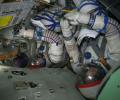
He also said it may be adopted for use in every stage of a rocket. He was speaking at the 16th convocation of SRM Institute of Science and Technology, near Chennai.

ISRO hopes to put a crew on the moon, but it has to learn how to keep people alive and healthy in space first.

India scripted history by successfully launching EMISAT, a military satellite, and 28 foreign nano satellites on-board its polar rocket from Sriharikota on Monday, in a complex mission which marked many a first for Indian Space Research Organisation.
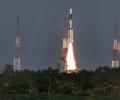
The satellite will enable a full range of services to neighbours including the areas of telecommunication, television, direct-to-home, VSATs, tele-education and tele-medicine.
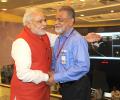
In his first interview, after the launch of MOM in Mars orbit, ISRO chief K Radhakrishnan spoke to T E Narasimhan about the mission and the way forward.

The RISAT-2B would replace the RISAT-2, which has been actively used by India to monitor activities in camps across the border in Pakistan to thwart infiltration bids by terrorists.
Research and markets estimated in May that the global opportunity for small and mini satellites would grow nearly one and half times to $5.32 billion by 2021

The primary goal of HysIS, whose mission life is five years, is to study the earth's surface in visible near infrared and shortwave infrared regions of the electromagnetic spectrum.

The 3,357-kg satellite, which was deployed from the lower passenger position of Ariane-5 launch vehicle (VA 251) into the geostationary transfer orbit, is configured on ISRO's enhanced I-3K Bus structure to provide communication services from Geostationary orbit in C and Ku bands.

The entire process being autonomous when the lander has to fire its engines at the right times and altitudes, use the right amount of fuel, and scan of the lunar surface for any obstacles or hills or craters before finally touching down.
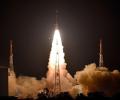
"I am really grateful to the entire ISRO family for having worked this hard and making IRNSS-1I a success," said the space centre's chief K Sivan.

This is the first mission by the Indian Speace Research Organisation this year.

The stage is set for the launch of India's satellite IRNSS-1D on Saturday from Sriharikota onboard workhorse PSLV-C27 that would pave the way for the country's own navigation system on par with the GPS of United States.

A truly 'made in India' satellite that will empower a digital India.

'Saying the private industry will come and transform India's space programme is real moonshine!'
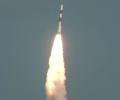
The launch marks a significant milestone for the space agency as it is the 50th flight of PSLV and the 75th vehicle mission from Sriharikota. The 628 kg satellite is meant for applications in various fields like agriculture, forestry and disaster management support. It would also serve military purposes.

India's first exclusive defence satellite GSAT-7 was successfully launched by European space consortium Arianespace's Ariane 5 rocket from Kourou spaceport in French Guiana on Friday, giving a major push to the country's maritime security.

Other than the Cartosat-2 series satellite, the PSLV is carrying 29 nano satellites from 14 countries - Austria, Belgium, Chile, Czech Republic, Finland, France, Germany, Italy, Japan, Latvia, Lithuania, Slovakia, the United Kingdom and the United States of America besides a nano satellite from India.

Some time before December 31, 2017, Bengaluru based Team Indus aims to land a vehicle on the moon.

The satellite would provide a thrust to mobile communication through multi-beam coverage facility, the ISRO said.
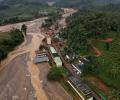
In the months immediately following the 2024 tragedy, reporting on the landslide per se had been a straightforward affair. On one side was death and destruction. On the other side, survivors and the business of survival. It was black and white. What direction to take was clear. Rehabilitation in comparison, felt like a complex situation. One that is fraught with shades of grey. As grey as human life, explains Shyam G Menon.

When the universe is your workspace, the sky is the limit, and there's no such thing as a glass ceiling. Divia Thani Daswani meets the women behind Mangalyaan

The successful orbiting of the satellites by the Polar Satellite Launch Vehicle PSLV C-40 comes four months after the Indian space Research Organisation's mission to launch backup navigation spacecraft IRNSS-1H onboard PSLV-39 ended in a rare failure.

Experts said attempts from China have increased in the last year, which further amplified after the Indian government banned Chinese applications post the Galwan clash.

In a textbook mission, ISRO's PSLV-C32 lifted off from Sriharikota and later injected the IRNSS-IF in sub-Geosynchronous Transfer Orbit.

The success of the PSLV-C34 mission is a result of ISRO's professionalism and the hard work put in by their scientists over the last many decades., says Ajay Lele.

The government has identified nine key focus areas in the AI national programme, including agriculture, education, Indian languages, smart cities, cybersecurity, transportation, and finance.

The GSAT-31 is a 'high power' communication satellite going to serve and replace some of the satellites that are going to expire soon.
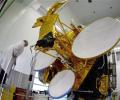
After 5 yrs, firm's offer to set up private satellites for digital push has seen some interest from Isro

India is set to operationalise its own navigational system with the successful launch of IRNSS-1D, the fourth in the series of seven navigational satellites, onboard PSLV-C27 from Sriharikota on Saturday.
 © 2026 Rediff.com - Advertise with us - Disclaimer - Privacy Policy - Sitemap - Feedback - About us - Terms of use - Grievances